
Six places to sleep
From 20 m to 4,278 m
We choose where you sleep before we choose where you go. The altitude of your bed decides how the next day feels.
Lodges, all run by us
Where most nights are spent
The single highest night, with oxygen


2,407 M
22°54′S 68°12′W
San Pedro de Atacama, Chile
Twenty-four suites in adobe and local stone, built low around a long pool and a garden of chañar trees. Every suite has a private terrace facing the Licancabur volcano, an oxygen concentrator on request, and heating for nights that drop below freezing.
The kitchen cooks with quinoa, rica-rica and goat cheese from the villages around the salar. Dinner is served late, by the fire, after the guides have briefed you on tomorrow.
Pool and hot tub facing Licancabur
Spa with altitude-recovery treatments
Observatory with a 16-inch telescope
24 adobe suites
2,450 M
22°56′S 68°10′W
Ayllu de Solor, San Pedro
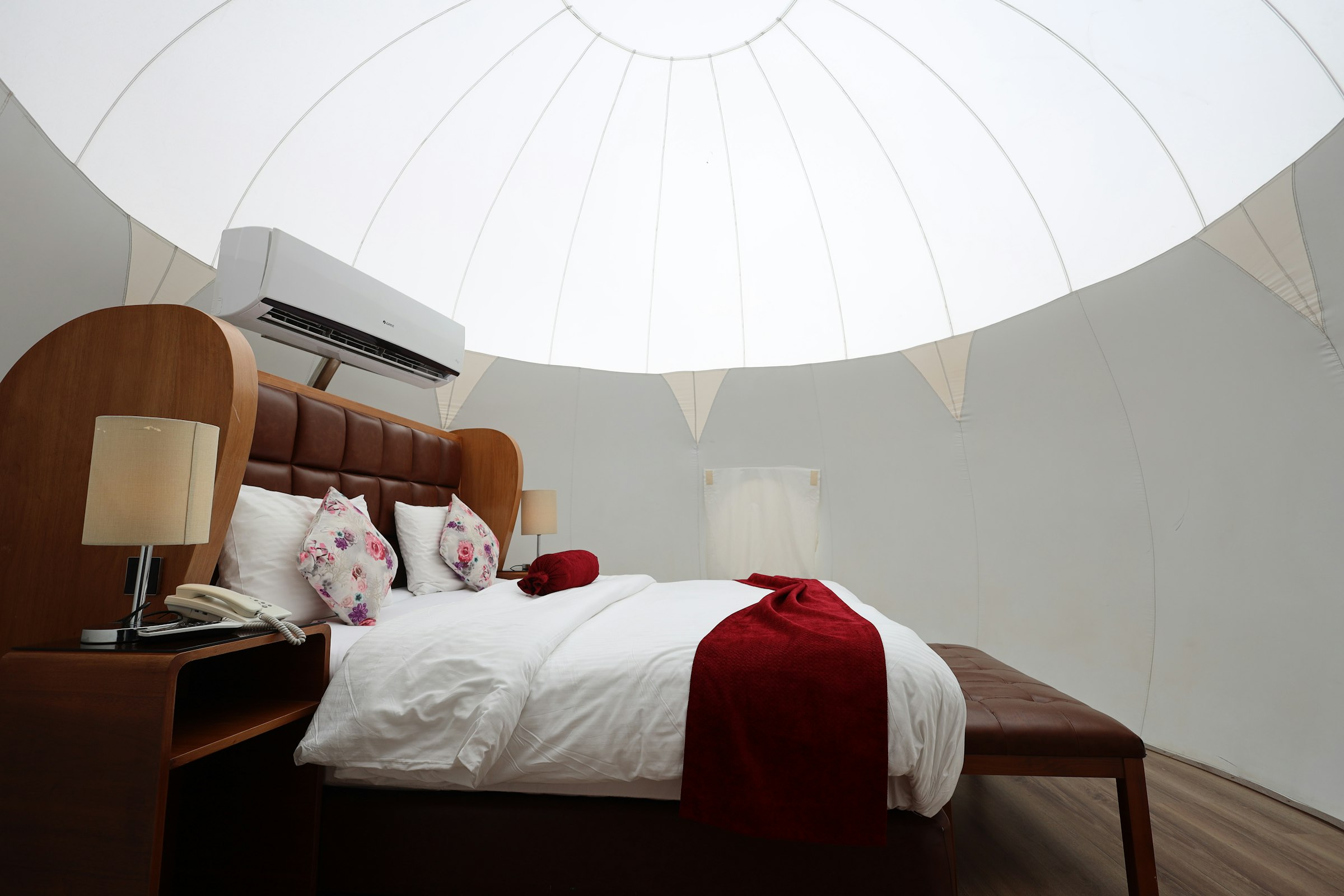
The domes stand in a row on a gravel terrace outside the village, far enough from town for the Milky Way to cast a faint glow. Each has a bed under a glass panel, a wood stove and a deck with a reclining chair for naked-eye stargazing.
The astronomer’s telescope sits at the end of the terrace. On clear nights, which is most of them, sessions run from nine until the guests give up.
Glass panel above every bed
Nightly telescope sessions
Wood stove and heated floors
8 glass-roof domes


3,200 M
22°39′S 68°10′W
Río Grande, Chile
Río Grande is a village of forty people and a church, in a canyon where the river keeps a strip of green alive. Our six rooms sit in a restored stone corral above the fields.
Guests stop here for a night between the lodge and the high lakes. It is the gentlest way to sleep a little higher before a big day.
Terraced gardens and a stream
Home-cooked village dinners
A one-night step to acclimatise
6 stone rooms


4,278 M
22°12′S 67°47′W
Laguna Colorada, Bolivia
The highest night on any of our journeys. The rooms are small, warm and quiet, each with piped oxygen and a pulse oximeter by the bed, and a guide sleeps on site.
Laguna Colorada turns red from the algae in its water, and three species of flamingo feed on them. Sunset here is short and very cold; the kitchen serves soup at five.
Piped oxygen in every room
A guide on site overnight
Flamingos at the water's edge
10 rooms with oxygen


3,660 M
20°17′S 67°02′W
Salar de Uyuni, Bolivia
Everything that can be made of salt is: the walls, the bar, the bases of the beds. The blocks are cut from the salar a few kilometres away and replaced as the rain wears them down.
From the terrace the flat runs white to the horizon. In the wet months it turns into a mirror; in the dry months you can drive across it for hours.
Walls and furniture of salt
Sunrise terrace on the salar
Private dinners on the flat
18 rooms built from salt


20 M
26°08′S 70°39′W
Pan de Azúcar, Chile
The camp sits inside the Pan de Azúcar national park, where the desert runs straight into the sea. The tents have proper beds, hot showers and decks over the sand.
Mornings start in the coastal fog, the camanchaca, that keeps the cactus gardens alive. By noon it burns off and the water turns a clear, cold blue.
Decks on the beach
Boat trips to the penguin island
Fog-garden walks at dawn
7 beach tents
02 — In every room
The small things that matter at altitude
01
Oxygen by the bed
A concentrator on request in every room, and piped oxygen above 4,000 m.
02
Heat that works
Radiant floors and wood stoves. Desert nights drop below freezing all year.
03
Water, everywhere
Filtered water in every room and vehicle. You will drink four litres a day.
04
A dark sky
Lights are shielded and switched off at ten. The telescope takes over.
05
A local kitchen
Quinoa, rica-rica and goat cheese from the villages around the salar.
06
Laundry, daily
Pack light. Every lodge washes and returns your clothes the same day.
Enquire →